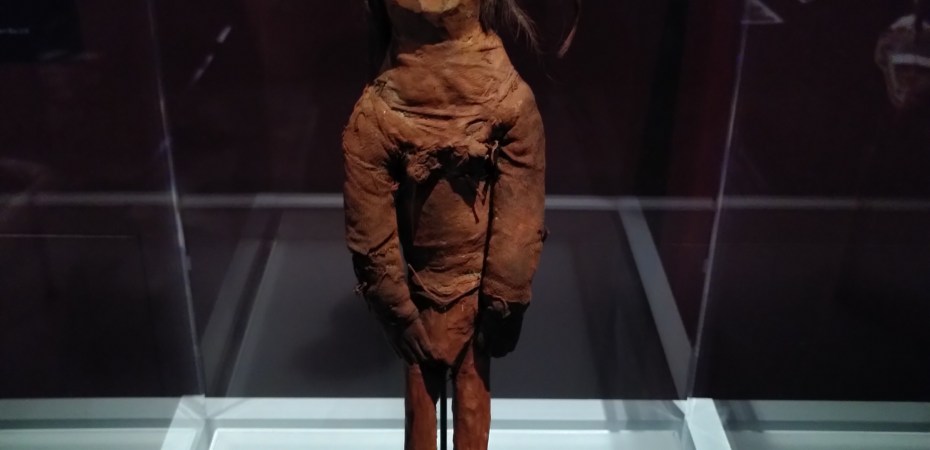
Many years ago there were very lavish and wanton alpine herders on the Flums alp of Ruhegg, of whom the Dairyman and the Assistant Dairyman called “Joggäli“. They cooked only the most delicious alpine dishes and always far more than they needed. What they were not able to eat, they put into a hollowed out stick in the hut, which they also called “Joggäli”.
When it was full, they scolded it and said: “You stupid Joggäli, why don’t you eat, since you are so well looked after? The wooden “Joggäli” seemed to have finally grown tired of the eternal scolding and, towards the end of the summer, to the horror of the herders, it really began to eat.
It was some comfort, however, that the time of the Alpentladung had come. Only the Dairyman had to remain alone in the hut for a few days to make cheese.
But the Assistant Dairyman had forgotten to take his milking stool home with him and only noticed this when he arrived at home.
He decided to fetch it. The memory of the Joggäli stick stirred some fear in him, but he plucked up courage and went, taking consecrated items with him for safety.
When he went under the door of the alpine hut, he saw several ghastly-looking men sitting around the hollow stick and feasting.
With a triumphant sneer, they pointed up under the roof of the hut, where the Dairyman was hanging on a harness rack, flayed, and the Joggäli called out in a hollow voice:
“Ä Joggäli Hand ihr gschundä,
Ä Joggäli Hand wir gschundä.
Und Joggäli wemmer meh schindä!”
The cowherd thought: “You’d better get out of here, Matthias, it’s the last chapter for you!” He took his milking-stool, on which the nearest of the sinister fellows was sitting, hurried out with it to the door of the hut, and escaped happily, but was still heard calling after him, “It was well for you that you had consecrated things with you; otherwise you would have fared badly!”
At the place where the unfortunate alpine dairyman hung, the people of Flums subsequently fixed a red grave cross, such as they have in their cemetery, and anyone who visits the alpine hut can still see it today. It is still as new, despite age and smoke from the hut.
J. Natsch
At the place where the “Joggäli” was flayed, there is now a black cross. People have often wanted to take it down into the valley and plant it in the cemetery, but it has always returned to the mountain pasture of its own accord.
K. Tschirki
The sin of which the herders were guilty was the waste of God’s gifts and the abuse of the sacrament of baptism.
O. Giger also tells of the sacrilege of the services, but calls the Joggäli a “Knochli” (small bone)
Editor’s note: This is one of the horrifying stories so far in the collection!
Alpentladung – Alp Unloading: leading the cows down from the mountains to their winter quarters in the valley.
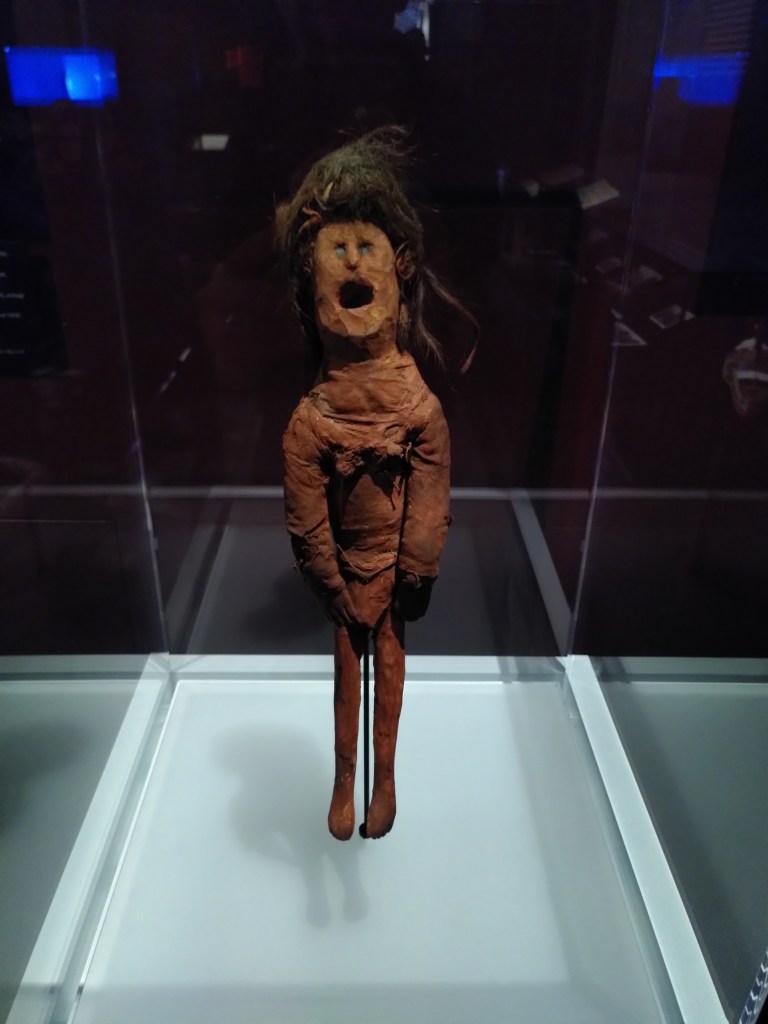
The Joggäli is described as a Stock, a stick or cane, but here, it is described as a doll or puppet of Dairyman, and there are several more versions of the story in the area also presented.
I’m not completely certain of the correct translation of what the Joggäli calls out. Another version is in a slightly different dialect:
«Joggäli hind er gschundä,
Joggäli haan i gschundä,
Joggäli will i meï schindä!»
schindä / gschundä = schinden / geschunden = to maltreat
So my take, based on the second version is:
“Joggäli he has mistreated,
“Joggäli I have mistreated,
“Joggäli I want to mistreat me!”
ChatGPT suggests ‘pushed’ rather than ‘mistreat’, but the rest if its translation attempt was not accurate.
Whatever, the correct translation is, it’s damn creepy!
There is a 2010 film, Sennentuntschi, that is based on a similar tale. If you are in Switzerland you should be able to find it on SRF Play.
Only one such puppet is known and was recently included in an exhibition on Swiss Folklore at the Zurich Landesmuseum – the photo for this entry was taken there. There is an article (in German) that explains more.
306. De drei Joggäli auf Ruhegg
Vor vielen Jahren waren auf der Flumser Alp Ruhegg sehr verschwenderische und mutwillige Alpknechte, von denen der Senn und Zusenn “Joggäli” hiessen. Sie kochten nur die leckerhaftesten Alpenspeisen und immer weit mehr als bloss für ihren Bedarf. Was sie nicht aufzuessen im stande waren, taten sie in einen ausgehöhlten Stock in der Hütte, welchen sie auch “Joggäli” tauften.
Wenn dieser voll geworden, schimpften sie über ihn und sprachen: “Du dummer Joggäli, warum frissest du nicht, da man dir doch so gut aufwartet?” Der hölzerne “Joggäli” schien endlich des ewigen Schimpfens müde geworden zu sein und fing gegen Ende des Sommers zum Schrecken der Knechte wirklich zu essen an,
Zum Trost war aber die Zeit der Alpentladung herangerückt. Nur der Senn musste noch für etliche Tage ganz allein in der Hütte zurückbleiben, um auszusennen.
Der Zusenn aber hatte vergessen, seinen Melkstuhl mit heimzunehmen und solches erst bemerkt, als er zu Hause angelangt war.
Er entschloss,sich, diesen zu holen. Zwar regte sich bei der Erinnerung an den Stock etwelche Furcht in ihm; allein er fasste Mut und ging, nahm aber zur Sicherheit geweihte Sachen mit.
Als er unter die Tür der Alphütte trat, erblickte er mehrere grässlich aussehende Männer, welche um den hohlen Stock herum sassen und sich gütlich taten.
Sie zeigten mit triumphierendem Hohne unter das Hüttendach hinauf, wo der ausgeschundene Senn an einem Geschirrgestell aufgehängt war, und riefen mit hohler Stimme:
“Ä Joggäli Hand ihr gschundä,
Ä Joggäli Hand wir gschundä.
Und Joggäli wemmer meh schindä!”
Der Zusenn dachte: “Da machst du, dass du fortkommst; sönst ist es mit dir Matthäi am letzten Kapitel!” Er nahm seinen Melkstuhl, auf welchem der nächste der unheimlichen Gesellen sass, eilte damit zur Hüttentüre hinaus und entkam glücklich, hörte aber noch nachrufen: “Es kam dir gut, dass du geweihte Sachen bei dir hattest; sonst wäre es dir übel ergangen!”
An dem Orte, wo der unglückliche Senn gehangen, befestigten die Flumser hernach ein rotes Grabkreuz, wie sie solche auf ihrem Friedhofe haben, und wer jene Alphütte besucht, kann dieses heute noch sehen. Es ist immer noch wie neu, trotz Alter und Hüttenrauch.
J. Natsch
An der Stelle, wo der “Joggäli” geschunden wurde, steht jetzt ein schwarzes Kreuz. Man wollte dieses schon oft ins Tal herunternehmen und auf dem Friedhof aufpflanzen; aber es kam allemal von selbst wieder auf die Alp zurück.
K. Tschirki
Die Sünde, deren die Alpknechte sich schuldig machten, ist die Verschwendung der Gottesgaben und der Missbrauch des Sakraments der Taufe.
O. Giger erzählt ebenfalls von dem Frevel der Alpknechte, nennt aber den Joggäli “Knochli”.
Photo of a Sennentuntschi (Joggäli) at the Zurich Landesmuseum (Feb 2023)
 Tales from the Swiss Mountains / Märchen aus den Schweizer Bergen