
































- 1. St. Gallus / Der heilige Gallus
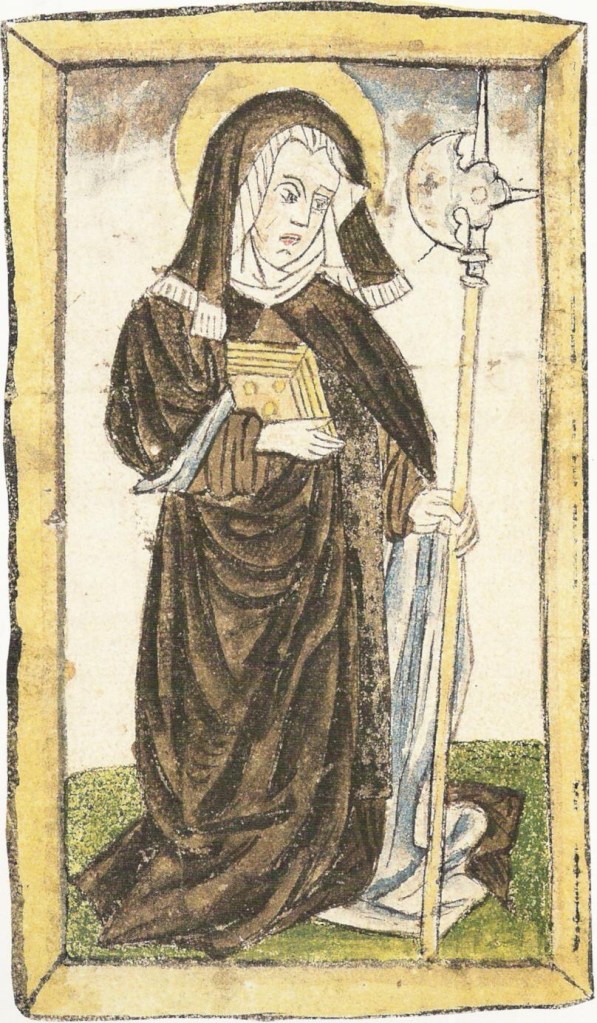
 After Gallus had recovered in Arbon by the grace of Christ, it soon became apparent that Divine Providence had kept him in the German country for higher things. He turned to the Deacon Hildibold, Willimar’s faithful comrade, who knew the area there better than anyone… Read more: 1. St. Gallus / Der heilige Gallus
 - 10. The Black House / Das schwarze Haus
 Near St. Georgen, behind the “Bädli“, stands the “Black House“. It is said that the sick were segregated in this house during the plague.Oral. Kuoni: The vernacular, which usually prefers to add rather than detract, seems to have lost essentials along the way. We often… Read more: 10. The Black House / Das schwarze Haus
 - 100. Wüetihö
 The Wüetihö is a many-legged black animal in the shape of a cat, but considerably larger than it. It roams the field or even the air at night with an eerie cry. According to N. Senn, Chronik Wüetihö Das Wüetihö ist ein vielbeiniges schwarzes Tier… Read more: 100. Wüetihö
 - 101. The Snake in Feldrietli / Die Schlange im Feldrietli
 A long time ago, a magnificent town stretched from the present town of Werdenberg to the long ditch towards Sevelen. Where the Feldrietli is now, there stood the stately castle, the seat of a Countess. She was a wicked, godless woman who had brought her… Read more: 101. The Snake in Feldrietli / Die Schlange im Feldrietli
 - 102. The Fast Post / Die schnelle Post
 A man from Grabs was serving as a soldier in Holland. One night he longed to know how things were at home. A woman who knew witchcraft was able to give him good advice. She handed him a broomstick on which he rode through the… Read more: 102. The Fast Post / Die schnelle Post
 - 103. The Evil Neighbour / Die böse Nachbarin
 Old Dorothea Hofmänner once heard something rustling outside her window before she fell asleep and saw a small dog slip in through a broken pane and sit on her chest. She could neither call out nor move until the fiend slipped away again the same… Read more: 103. The Evil Neighbour / Die böse Nachbarin
 - 104. The Schrättlig / Der Schrättlig
 A maiden from Grabs became pale and lost weight. When questioned, she explained that she was crushed terribly every night by a “Schrättlig“. She was advised to hold a sharp knife to the monster. She did so when he came; he drove himself onto the… Read more: 104. The Schrättlig / Der Schrättlig
 - 105. The Witch as a Fly / Die Hexe als Fliege
 A young man from Grabs left his mistress and took a signing fee for Dutch mercenary service. So he left and became a soldier. One day a fly stung him. The man died from it, for all medical help was in vain. It turned out… Read more: 105. The Witch as a Fly / Die Hexe als Fliege
 - 106. If one doesn’t hear correctly / Wenn man nicht recht hört
 A witch went out on a broomstick. Her magic spell was: “Through the chimney and no-where else!” Another person, who was watching but did not understand the spell, wanted to follow her, but said: “Through the chimney and everywhere else!” Then they went up into… Read more: 106. If one doesn’t hear correctly / Wenn man nicht recht hört
 - 107. Of the Stumpers and Markenrückers / Von den Stumpern und Markenrückern
 Since the land in the Werdenberg region is highly fragmented, the cattle cannot usually be grazed in autumn, but only “stumped”. Each animal is tied to the meadow by means of a two to three metre long so-called “hitch” that can be turned on a… Read more: 107. Of the Stumpers and Markenrückers / Von den Stumpern und Markenrückern
 - 108. Entranced and deceived / Entrückt und irregeführt
 Half an hour to the north-east of Grabs, in the valley plain, lie some estates which bear the name Gula. A man from Grabs wanted to go there at nightfall to wait for his cattle. He had been walking for an unreasonably long time and… Read more: 108. Entranced and deceived / Entrückt und irregeführt
 - 109. The Man in Black without a Head / Der schwarze Mann ohne Kopf
 It is quite “unghür” (monstrous) on the ride between Werdenberg and Haag, but mainly near the gallows. There you can often see a huge man in black who accompanies any nocturnal hikers for a while, but then disappears. A man from Werdenberg, returning from the… Read more: 109. The Man in Black without a Head / Der schwarze Mann ohne Kopf
 - 11. The Wayside Shrine near Kappel / Der Bildstock bei Kappel
 Holy Father Gallus, in his old age, went once more from where he had come to consolidate a place of Christian splendour through his work. In Arbor Felix he ascended the pulpit for the last time in order to describe the downfall of all earthly… Read more: 11. The Wayside Shrine near Kappel / Der Bildstock bei Kappel
 - 110. The Ghost / Der Geist
 Below Werdenberg, by the Mädli bridge, you can see a man in black; hunched over, he walks up and down behind the fields and oaks, along the old road. Woe to anyone who disturbs this evil spirit! Heinrich Hilty. Der Geist Unter Werdenberg, bei der… Read more: 110. The Ghost / Der Geist
 - 111. With Twisted Head / Mit verdrehtem Kopf
 The cane and gallows, or higher jurisdiction, lay with the sovereign, formerly with the Counts of Werdenberg, later with the bailiff of Glarus. It was a peculiar right here that criminals were not allowed to be led across the territory of the small town; for… Read more: 111. With Twisted Head / Mit verdrehtem Kopf
 - 112. An Unsought Encounter / Eine ungesuchte Begegnung
 A carpenter from Grabs was once walking home from Buchs late at night. He had been working there. As he came to the Studner bridge, a man in black who must have risen from the ground suddenly stood in front of him. Without saying a… Read more: 112. An Unsought Encounter / Eine ungesuchte Begegnung
 - 113. Hujum!
 “Hujum! Wela chnunt und cheart mi um!” is the challenge to a duel. It is especially directed at the “Stubeti boys” who do not want to reveal their identity on the street. A man from Grabsberg heard this call from a barn on his way… Read more: 113. Hujum!
 - 114. The People of the Dead or Night People / Das Totenvolk oder Nachtvolk
 The people of the dead move through the village at night in long funeral processions. Every single person who takes part in the procession can be recognised quite clearly. Most of them are deceased, but there are also living people who join them; of course,… Read more: 114. The People of the Dead or Night People / Das Totenvolk oder Nachtvolk
 - 115. Gold
 A woman was gathering wood in the castle forest, saw pretty, shiny leaves and took a handful home for her child. But how astonished she was when each leaf became a piece of gold! The mother hurriedly went back to the forest to fetch more,… Read more: 115. Gold
 - 116. The Venetian / Venediger
 Our mountains are rich in ore. The Venetians knew this a long time ago; they came here and collected precious stones in their sacks. They said that many here had thrown a stone at a cow that was worth more than the cow itself. But… Read more: 116. The Venetian / Venediger
 - 117. The Lindworm / Der Lindwurm
 Once upon a time a terrible lindworm lived on the Grabs Alp. It was as big as a tree trunk, dark red in colour and, according to its nature, extraordinarily vicious; for it ate people and animals. To get rid of him, the people of… Read more: 117. The Lindworm / Der Lindwurm
 - 118. Mandrake / Alraune
 It is well known that much magic was done with the mandrake root in the past. All kinds of human figures were carved from it, which were thought to have magical powers. In Werdenberg, the mandrake was also believed to be a real cat-like animal… Read more: 118. Mandrake / Alraune
 - 119. White Clover / Der weisse Klee
 The bees avoid the white clover, while they love the red. In the white clover, the honey droplet sits so deep in the narrow tubes that they cannot reach it with their proboscis. But folklore knows differently. The bees used to make no distinction and… Read more: 119. White Clover / Der weisse Klee
 - 12. Ramswag / Die Ramswag
 A Knight, Sir Heinrich Walther von Ramswag, went out with King Rudolf von Habsburg against the Bohemian King Ottokar and saved his lord’s life in the battle of Marchfelde (26 Aug. 1278). For this he was royally rewarded; he received 500 marks of silver, the… Read more: 12. Ramswag / Die Ramswag
 - 120. The Plague / Die Pest
 In late summer, a dairyman from the Malbun alp wanted to go down into the valley; there he no longer found his friends and relatives. Most of them had died. Weeping, he returned to the alp and wanted to tell his companions how he had… Read more: 120. The Plague / Die Pest
 - 121. Wildenmannslöchli Cave / Wildenmannslöchli
 Not far from the Buchserberg houses is the Wildenmannslöchli, a rock cave which, many say, goes half an hour into the mountain. Under the ground, however, distances are usually overestimated. The cave branches out at a depth of about a hundred paces into three smaller… Read more: 121. Wildenmannslöchli Cave / Wildenmannslöchli
 - 122. Toothache / Zahnweh
 A poor man from Rans, who was looking for dry wood in the Geitzbachtobel, on the Buchserberg, fell off a rock and broke his leg. He had to lie there all afternoon and the following night, calling for help from time to time. Finally a… Read more: 122. Toothache / Zahnweh
 - 123. Föhn weather, the worst weather / Föhnwetter, das schlechteste Wetter
 A man from Buchs, when he was feeding his cattle in a cottage on the mountain, was often visited by a wild man. Not far from there was the Wildenmannslöchli, the latter’s home. One day the man from Buchs said to the Wildmannli, “You! Next… Read more: 123. Föhn weather, the worst weather / Föhnwetter, das schlechteste Wetter
 - 124. The streams must not be polluted / Die Bäche dürfen nicht verunreinigt werden
 The streams must not be polluted, because in many places the inhabitants of whole parts of the village draw the water they need from so-called well streams. If a boy polluted the stream, he was told by the other boys to say three Our Fathers;… Read more: 124. The streams must not be polluted / Die Bäche dürfen nicht verunreinigt werden
 - 125. Reindeer Lichen / Rentierflechte
 A poor, old, staggering Wildmannli once visited the Malbun Alp and begged the herdsmen for a little buttermilk, but was scolded for being a day thief, lazy, good-for-nothing, etc., and chased away. He left, but turned around again and called out across the alp: “Cursed… Read more: 125. Reindeer Lichen / Rentierflechte
 - 126. The Fiery Dragon on the Maltschül Alp / Der feurige Drache in der Alp Maltschül
 There is a fiery dragon under the red plate on the Maltschül Alp. However, it only appears before a flood. In 1762 and 1764, a fiery man rode out on the dragon through the Buchserbachtobel, and soon after a flood came, which swept away houses… Read more: 126. The Fiery Dragon on the Maltschül Alp / Der feurige Drache in der Alp Maltschül
 - 127. The One-Eyed Hound / Der einäugige Hund
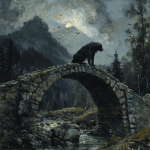 Near Räsis, at the Sarbrücke, the late hiker encounters a large, black dog with only one eye. It sits in the middle of the forehead, but is as big as a “bull’s eye”. Heinrich Hilty Der einäugige Hund Nahe bei Räsis, an der Sarbrücke, begegnet… Read more: 127. The One-Eyed Hound / Der einäugige Hund
 - 128. The Headless Woman / Das Weib ohne Kopf
 A hundred years ago, a man from Altendorf was herding his cattle in the fields. He noticed an unknown old woman sitting on a tree, wearing a bad straw hat. When he approached her, he saw that she was headless. He was frightened, went home,… Read more: 128. The Headless Woman / Das Weib ohne Kopf
 - 129. The Rider on the Farnboden Alp / Der Reiter in der Alp Farnboden
 At night time, a man from Altendorf saw a man on a white horse riding up through Stafanell on the Farnboden Alp (Sevelen). He thought he recognised in this ghostly figure a man who had died some years ago. Others also claim to have seen… Read more: 129. The Rider on the Farnboden Alp / Der Reiter in der Alp Farnboden
 - 13. The Sunken Town / Die versunkene Stadt
 Where the Hudelmoos is today, there once stood a town which – probably as just punishment for sins committed – sank into the depths. Old people claim to have heard the ringing of bells from down there. I. Weber Die versunkene Stadt Wo heute das… Read more: 13. The Sunken Town / Die versunkene Stadt
 - 130. How to learn to pray in times of need / Wie man in der Not beten lernt
 During a storm on the alp, two men from Räfis, Baba-Hans and Long-Badist, took refuge in a hut on the Buchserberg; they sat close together, trembling behind the little table; for a long time, not a sound came from their lips. Heavy raindrops pattered on… Read more: 130. How to learn to pray in times of need / Wie man in der Not beten lernt
 - 131. The Growling Ditch / Das Grabengröll
 The field on both sides of the country road between Sevelen and Räsis is called “the long ditch”. For more than half an hour of the road there was no other building here thirty years ago than an old barn, the Grabenstall. This stretch of… Read more: 131. The Growling Ditch / Das Grabengröll
 - 132. The Gräggi / Das Gräggi
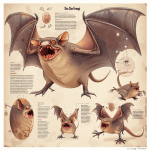 The Gräggi is a little animal the size of a pumpkin, but which sometimes flies, sometimes merely hops, runs, rumbles and cries out in all sorts of voices in a whimsical and sinister way. It is in hill and dale. A man from Burgerau was… Read more: 132. The Gräggi / Das Gräggi
 - 133. God bless you /Helf dir Gott
 A man from Burgerau was once walking home at midnight by the “Stiegelen” and heard someone sneeze. He said, “God bless you!” It happened again, and he made the same pious wish. The third time, however, the Burgerauer lost his patience and cried out unwillingly,… Read more: 133. God bless you /Helf dir Gott
 - 134. Banished / Verbannt
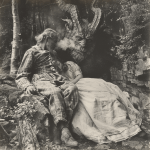 The Capuchins can banish spirits, who become a nuisance in inhabited places, to a lonely spot; two of these cowled men simply take him into their midst and walk with him one fine morning to the agreed new abode. Whoever happens to meet them has… Read more: 134. Banished / Verbannt
 - 135. From the time of the Plague / Aus der Pestzeit
 Once the black death raged so strongly that if you stuck a hazel stick into a window of a plague-ridden house, it immediately turned black. At the time of the plague, when the angel of death was claiming many victims, an estate on the Sevelerberg… Read more: 135. From the time of the Plague / Aus der Pestzeit
 - 136. The Treasure Diggers / Die Schatzgräber
 In the area of the municipality of Sevelen stands the Herrenberg ruins, in which, according to popular belief, great treasures could still be found. A few years ago, some men attempted to dig them up. They obtained a scroll that could be used for magic,… Read more: 136. The Treasure Diggers / Die Schatzgräber
 - 137. The Giant / Der Riese
 On the alp “Altsäss”, whenever the dairymen took the milking stool down to the lower alp, it would always return to the upper alp. Once, the dairyman instructed the boy to bring the stool down from the upper alp and promised him his beautiful goat… Read more: 137. The Giant / Der Riese
 - 138. The Fell Man of Altsäss Alp / Der Fahlmann in der Alp Altsäss
 The Fell in Altsäss (Old Seat) is a very steep slope interrupted by rocky outcrops, which reaches down to the stream that separates the Altsäss and Maltschül alps. A narrow footpath leads over it, the Fahlwegli (Fellway), which is extremely “time-worn” for cows and horses… Read more: 138. The Fell Man of Altsäss Alp / Der Fahlmann in der Alp Altsäss
 - 139. The Plate Woman / Das Plattenwibli
 The Seveler carpenter S. G. once went to Oberschan “zur Spinni” (to the pub). As he was returning home through the Seveler woods early in the morning – it was not yet daylight – he saw a woman in the beech forest, close to the… Read more: 139. The Plate Woman / Das Plattenwibli
 - 14. The Wood Nanny / D’ Holz-Nann
 Many, many years ago, there was nothing unusual in the woods at Winkästeig [Winkenstieg] and Pfi [Pfyn/Pfin], near Muolä [Muolen]. In the neighbourhood near Risershus, the Wood-Nanny lived; she was in the forest more than she was at home. But she had a lot of… Read more: 14. The Wood Nanny / D’ Holz-Nann
 - 140. The Cow-backs on the Altsäss alpine pasture / Das Kuhrücken auf der Alp Altsäss
 “Hans,” said the dairyman of the Altsäss alp to his boy one evening, “the Trappli has announced it; the cows are digging, and it’s snowing that night; tomorrow I’m leaving the alp; bring the sled here.” And indeed, it happened as the alpine dairyman had… Read more: 140. The Cow-backs on the Altsäss alpine pasture / Das Kuhrücken auf der Alp Altsäss
 - 141. The Geissbachzopfi / Der Geissbachzopfi
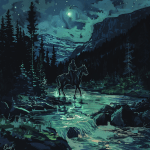 The Geissbachzopfi rides down the Schreja at the witching hour on a white horse near Majenpfüsis. A man from Sevelen with the nickname Wäspi once saw him; the following morning he had a swollen head. Heinrich Hilty. Der Geissbachzopfi reitet zur Geisterstunde auf einem Schimmel… Read more: 141. The Geissbachzopfi / Der Geissbachzopfi
 - 142. The Schrättlig / Der Schrättlig
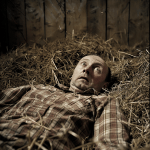 An old Seveler told me the following: When I was young, one evening I was lying on the cot in my father’s cowshed on the Majenberg, half asleep, half awake. The upper part of the stable door was open. Something came in and sat on… Read more: 142. The Schrättlig / Der Schrättlig
 - 143 The White Woman / Die weisse Frau
 In an old house in Sevelen, which was spared in the great fire of 1892, a white woman walks around, but she is a malicious creature. When the blossoming nineteen-year-old daughter of the house once went into the cellar at night time, the woman appeared… Read more: 143 The White Woman / Die weisse Frau
 - 144. The Frozen Goats / Die “gstellten” Ziegen
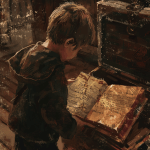 When Mühli-Leart (Mühle-Leonhard), who died many years ago, was still young and snooping around the house like a boy, he found a book riddled with worms in an old chest in the attic. There were strange signs and words in it. They seemed so funny… Read more: 144. The Frozen Goats / Die “gstellten” Ziegen
 - 145. The Ditch Dog / Der Grabenhund
 In the “long ditch” at night time appears a sinister dog, the ditch-dog, who accompanies passers-by for a distance. Heinrich Hilty. Der Grabenhund Im “langen Graben” erscheint zur Nachtzeit ein unheimlicher Hund, der Grabenhund, der die Passanten eine Strecke weit begleitet.Heinrich Hilty.
 - 146. Two Cattle in a Chain / Zwei Rinder in einer Kette
 “I am certainly not superstitious, and yet something happened to me where things did not go with natural things,” Stega-Leart (Leonhard), generally known as a free spirit, told me. “One evening I had left my cattle well tied up in the stable at Montjol and… Read more: 146. Two Cattle in a Chain / Zwei Rinder in einer Kette
 - 147 The banished spirit of the Pastor’s Wife / Der verbannte Geist der Frau Pfarrer
 Samuel Schmid served as pastor in Sevelen from 1728 to 1771. His wife died. It is not known what she had done wrong, but from the time of her death onwards, the vicarage was no longer* haunted; a strange creature haunted the inhabitants of the… Read more: 147 The banished spirit of the Pastor’s Wife / Der verbannte Geist der Frau Pfarrer
 - 148. The Schrättlig on the Hackle / Der Schrättlig auf der Hechel
 In Rans a young man was so terribly afflicted by a Schrättlig that he became ill, paler and weaker. Finally, someone advised him to take a witch’s hackle to bed and lay it on his chest, with the tips pointing upwards, of course. The witch… Read more: 148. The Schrättlig on the Hackle / Der Schrättlig auf der Hechel
 - 149. The Witch at the Window / Die Hexe am Fenster
 A young man told me that he was not at all superstitious, but that he had once seen something late at night that seemed strange to him. A cat had been on the window sill in front of a farmhouse and had cleaned the windows… Read more: 149. The Witch at the Window / Die Hexe am Fenster
 - 15. The Gallus Spring / Der Gallenbrunnen
 On his hike through the Arbon forest, Gallus also came to a spring. He drank from it and blessed it in return. The spring is called the Gallenbrunnen. It is near Mörschwil. Even today, people like to draw drinking water from here. Oral history Der… Read more: 15. The Gallus Spring / Der Gallenbrunnen
 - 150. Cake / Kuchen
 Two lads went to the Seveler-Mountain for a “Stubete” (Courting). The two girls of the house were happy about the visit and went to the kitchen to bake cakes. The boys could see into the kitchen through a crack in the door. What did they… Read more: 150. Cake / Kuchen
 - 151. The Plague, 1629 / Die Pest, 1629
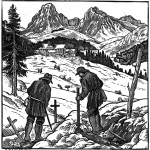 Gretschins also knows the saying: Seven Hans in one grave!Is that not a great lament? The deaths were so frequent that the bells were no longer rung at the funerals and no church service was held. The pastor thought that under these circumstances he no… Read more: 151. The Plague, 1629 / Die Pest, 1629
 - 152. Stolen Bells / Glocken gestohlen
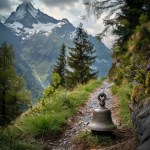 One morning a bell disappeared from the church tower in Gretschins and no trace of it could be found. Some time later, when the sacristan of Balzers invited the faithful to devout prayer, the people of Wartau heard very familiar sounds. These sounds came from… Read more: 152. Stolen Bells / Glocken gestohlen
 - 153. The Little Tufa Man / ‘s Tufmannli
 Schaan (Oberschan) is the oldest village in the world. Many, many years ago, the native people didn’t know where they were coming from, but when one man came to the village, they never knew. Now it’s been said that it’s from tufa, and then it’s… Read more: 153. The Little Tufa Man / ‘s Tufmannli
 - 154. The Ancient Palfriesians \ Die alten Palfrieser
 Palfries was once inhabited by the free Walsers. At the entrance to the alp, the “Kammjos” had his home. One morning his daughter jumped out of the kitchen into the parlour and called out with an expression of great astonishment: “Father, the water has gone… Read more: 154. The Ancient Palfriesians \ Die alten Palfrieser
 - 155. The Dance at Palfries / Der Tanz auf Palfries
 The farmhands on the “Bäschneralp” had decided to have a fun day, and for this purpose they ordered two fiddlers and some girls from the village of Bärschis to the alp. With them they went to the neighbouring Alp Palfries, where there was a proper… Read more: 155. The Dance at Palfries / Der Tanz auf Palfries
 - 156. The Dragon / Der Drache
 A dragon lived near Azmoos, and it was said that as soon as it moved its tail, the village would be buried by the mountain. Dr. Henne-Am Rhyn, German Folk Tale. This is the Trübbach, truly a vicious dragon. 156. Der Drache Bei Azmoos hauste… Read more: 156. The Dragon / Der Drache
 - 157. Wartau Castle / Schloss Wartau
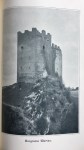 When the castle was built, the lords of the castle had the mortar stirred with pure wine; that is why it is still so iron-resistant today. U. Adank Schloss Wartau Beim Bau der Burg liessen die Zwingherren den Mörtel mit purem Weine rühren; darum ist… Read more: 157. Wartau Castle / Schloss Wartau
 - 158. The Betrayal / Der Verrat
 The lords of the castle led a debauched lifestyle. They often went into the courtyard with their guests and boasted, cheered, raved and played with their golden skittles. During one such hour, a maid gave the outraged subjects an appointed signal. Thereupon they stormed against… Read more: 158. The Betrayal / Der Verrat
 - 159. The Dangerous Bakery / Die gefährliche Bäckerei
 When the lords of the castle were committing one atrocity and outrage after another, the subjects instigated a conspiracy. A maid staying at the castle, a daughter of Oberschan, was drawn into the secret. While baking, she managed to press the gate key into a… Read more: 159. The Dangerous Bakery / Die gefährliche Bäckerei
 - 16. The Church / Die Kirche
 According to an old tradition, there was a brother chapel in Mörschwil. In 1494, a number of dead bodies were found in a site surrounded by old masonry. The place got a wayside shrine to which people went on pilgrimage, then a chapel, then the… Read more: 16. The Church / Die Kirche
 - 160. The Golden Skittles Game / Das goldene Kegelspiel
 A servant, Friedrich, fell in love with the daughter of the lord of the castle. The latter strongly opposed the union. But the determined youth fled secretly with his beloved. In Sargans he hoped to achieve his goal. The furious Lord of the Castle, however,… Read more: 160. The Golden Skittles Game / Das goldene Kegelspiel
 - 161. The Fratricide / Der Brudermord
 Once upon a time, the noble Count Wilhelm lived in Wartau Castle, mild towards his subjects and friendly towards his own. But the younger brother, who came home from distant wars and lusted after the possession of the countess and the beautiful dominion, disturbed the… Read more: 161. The Fratricide / Der Brudermord
 - 162. The Four Musicians / Die vier Musikanten
 Once at night four musicians passed by the red beeches in a merry mood. There they agreed to play a piece in honour of the deceased count. While they were playing, the count appeared in white robes, gave them each a leaf and immediately disappeared… Read more: 162. The Four Musicians / Die vier Musikanten
 - 163. The Sheet full of Wheat / Das Tuch voll WeizenTo the south of Wartau Castle, below the wall, there is a path around the castle head. On a Holy Good Friday, the old Lord Weber was walking around the castle and to his great astonishment saw a silk cloth spread out, covered with the… Read more: 163. The Sheet full of Wheat / Das Tuch voll Weizen
- 164. The Seven Foxes / Sieben Füchse
 From the hamlet of Plattis, a road leads to the village of Gretschins. On the top of a rock on the right, there are still remains of a wall, popularly known as “the brocha castle”. A footpath leads northwards through the beautiful Buchwald forest through… Read more: 164. The Seven Foxes / Sieben Füchse
 - 165. The Spinner in the Lafadarsch Forest / Die Spinnerin im Lafadarschwalde
 In Uzmoos, in the Lafadarsch Forest, the spinning of a spinning wheel can be heard incessantly on autumn nights. But the industrious spinner has never been seen. It is said that these sounds come from the water, which in many places falls drop by drop… Read more: 165. The Spinner in the Lafadarsch Forest / Die Spinnerin im Lafadarschwalde
 - 166. The “Fährlisau” with its young at Kropfen Well / Die “Fährlisau” mit ihren Jungen beim Kropfenbrünneli
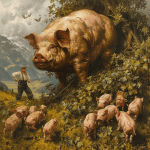 Before you reach Gretschins from Oberschan via Malierfi, you come to the Kropfenbrünneli (Kropfen Well). This is a very disreputable place. When a man passed by there on New Year’s Eve, he heard the squealing of young pigs. He ran after these sounds and found… Read more: 166. The “Fährlisau” with its young at Kropfen Well / Die “Fährlisau” mit ihren Jungen beim Kropfenbrünneli
 - 167. The Markenrücker of Gaplon / Der Markenrücker auf Gaplon
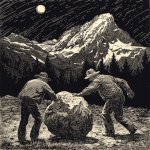 A man in the Kreuzgässli (Cross Lane) near Oberschan was woken up in the middle of the night by heavy knocking, as if someone wanted to get in. The man from Oberschan was not willing to let his night’s rest be robbed and went back… Read more: 167. The Markenrücker of Gaplon / Der Markenrücker auf Gaplon
 - 168. The Schrättlig / Der Schrättlig
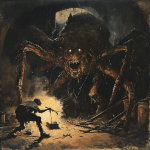 In a blacksmith’s shop, the Schrättlig came in, and when it was banished, a straw was lying on the floor of the room. The blacksmith, not being lazy, put it in the vice and made it tight. In the morning the witch was stuck in… Read more: 168. The Schrättlig / Der Schrättlig
 - 169. The Pfaffenchelleri / Die Pfaffenchelleri
 A beautiful footpath leads from Sevelen over the Heuberg and the Selva to the “brochnen Castle” (Procha Castle?) and on to Gretschins. A side path branches off to Oberschan; from just before this point you cross a small stream. There, at midnight, a woman appears… Read more: 169. The Pfaffenchelleri / Die Pfaffenchelleri
 - 17. Möttelin / Die Möttelin
 This is where the Möttelin had their family tomb, as this rich family had made rich donations to the church. The coat of arms is carved in stone next to the tower. “The noble and old Joachim von Rappenstein, called Möttelin, is buried here. He… Read more: 17. Möttelin / Die Möttelin
 - 170. The Post Hound
 When the road still stretched through the narrow lane to Weite next to the Gufelstein, a dog regularly accompanied the journeys. After the new road was built around the Lonna Hill, the dog continued to follow the same route for many years. Ch. Berger Editor’s… Read more: 170. The Post Hound
 - 171. How Sargans got its name / Wie Sargans zu seinem Namen gekommen
 When the first inhabitants of Sargans were at a loss as to what name to give the village, they went to the nearby Saar River and decided that the village should be named after the river and the first object that came floating down it,… Read more: 171. How Sargans got its name<em> / </em>Wie Sargans zu seinem Namen gekommen
 - 172. The Urtel / Das Urtel
 Not far from the small town of Sargans, on the ride towards the railway station, there is a large spring hole called “Urtel“. A town once stood here, which perished as a punishment for the immorality of its inhabitants. The unfathomably deep hole is the… Read more: 172. The Urtel / Das Urtel
 - 173. The Toad / Die Kröte
 Beneath the church, on an unfathomably deep water, rests a huge toad. If it turns around once, the church will collapse. Dr. Henne-Am Rhyn, German folk tale. Kuoni note: Probably the most original explanation for an earthquake. Die Kröte Unter der Kirche ruht auf einem… Read more: 173. The Toad / Die Kröte
 - 174. St. Eloi
 St. Eloi is the patron saint of blacksmiths. It is said that he cut off the legs of horses so that they could be shod more easily and then put them back on. His image was also attached to the Splee chapel near Sargans. When… Read more: 174. St. Eloi
 - 175. The Froshas / Der Froshas
 If the children in and around Sargans are naughty, or if they still roam the streets and make noise in the evening after ringing the prayer bell, the Froshas fetch them. He carries them into Valeis Ravine and throws them down Kirchturmstief (Church Steeple Deep)… Read more: 175. The Froshas / Der Froshas
 - 176. The Gräggi / Das Gräggi
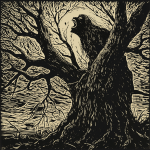 In Sarganserland, Wodan’s place is taken by the “Bachgeschrei” (Brook Screamer), but above all by the “Gräggi“, i.e. the screamer who lies in the path at night, sometimes as a tree trunk, a dog, a pig or a calf, or who screams at you from… Read more: 176. The Gräggi / Das Gräggi
 - 177. The Dwarf in Ore Hole / Das Bergmännli im Erzloch
 In the almost 600-metre-high rock face of the Gonzenhaupt is an iron mine that was probably already in use in Roman times, called the “Erzloch” (Ore Hole) by the people of Sargans. It was still in operation until around 1870. A dwarf, a benevolent mountain… Read more: 177. The Dwarf in Ore Hole / Das Bergmännli im Erzloch
 - 178. The Dwarves of Gonzen / Die Zwerge am Gonzen
 The Gonzen also had its little dwarves, which is almost a matter of course with an old man so rich in stories. They lived up at the Erzbild (ore mine) in the deep holes from which the cool wind rises. Their houses were of iron… Read more: 178. The Dwarves of Gonzen / Die Zwerge am Gonzen
 - 179. In Sargans Castle / Im Schloss Sargans
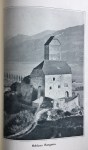 In Sargans, there must naturally be ghosts haunting the castle, whether one wants it or not; in old castles, ghosts always have the right of way because in the past, arrogance, overconfidence, money, and injustice were the rule. People still fear them today, and I… Read more: 179. In Sargans Castle / Im Schloss Sargans
 - 18 The Schrättlig / Der Schrättlig
 The Schrättlig often came into our house at night and tormented this and that member of the family. Once, we gave the fiend the slip and in the morning found a straw lying on the parlour floor, which we worked on with hammers and axes.… Read more: 18 The Schrättlig / Der Schrättlig
 - 180. The Splee Chapel / Kapelle Splee
 Many people don’t have the courage to go up to the Splee Chapel at midnight, when a wild goat or a black cat is standing in your way. And in the cemetery, they wouldn’t dare at night, and there it’s probably the safest; the dead… Read more: 180. The Splee Chapel / Kapelle Splee
 - 181. The Money Hoard of Girenbüchel / Der Geldschatz vom Girenbüchel
 In 1792, Judge Anrig, the father of the cashier Anrig in the Töbeli at Sargans, had a farmhand who had to look after the cattle on his estate Atschen, which lies on the high slopes of the Schollberge. One day he came home in a… Read more: 181. The Money Hoard of Girenbüchel / Der Geldschatz vom Girenbüchel
 - 182. All Kinds of Magic / Allerlei Zauber
 The old Mingli in the field was also a kind of half-wizard; he could drive away snails, believe it or not! And against the witches, he fought in the barn with “Wichtwasser” (a magical water). The old woman from Baschär in Jude-Winggel once told us… Read more: 182. All Kinds of Magic / Allerlei Zauber
 - 183. Placed / Gestellt
 Our beautifully carved church pews are said to have been made by a Wildmannli who travelled far and wide in the world. Once two of his travelling companions wanted to rob him of his money, but he immediately bound them so that they could no… Read more: 183. Placed / Gestellt
 - 184. On the Bastion Wall / An der BasatienwandOn the bastion wall near Sargans, one often hears shouting, wailing and lamenting on moonlit nights. This comes from two lovers who died unhappily there. There lived in Proder Feld, Rupp the bold boy and Mathilde. Once Count Kuno, who also liked the girl, came… Read more: 184. On the Bastion Wall / An der Basatienwand
- 185. The Fox in the Sack / Der Fuchs im Sack
 We’ve already heard a lot about the burning men, the Schrättlig and the Grääggi. But one peculiar experience is of Peter Geel from Vild. He went out at night from Mels to the town through the woods. A fox came to him and pretended to… Read more: 185. The Fox in the Sack / Der Fuchs im Sack
 - 186. Old Maids / Alte Jungfern
 According to an old legend of the people of Sargans, the girls, who all become spinsters through their own fault, are supposed to gather after their death at the “grossen Riete” (great moors) near Schan, in Liechtenstein, and spend their time there piously and demurely… Read more: 186. Old Maids / Alte Jungfern
 - 187. The Violinist on the Gallows / Der Geiger auf dem Galgen
 Violinist Hans-Jöri went late in the evening across the Rhine to Liechtenstein, where he was to play. When he reached Balzers, it was already dark. Unexpectedly, he was called aside by smartly dressed people on the street and met a brilliant company. He was invited… Read more: 187. The Violinist on the Gallows / Der Geiger auf dem Galgen
 - 188. Called by the Dead / Zu den Toten gerufen
 On Oberprod, 100 years ago, there lived a tree-strong man, Bartholomäus Lutz. One evening, as he was about to go to rest and was stripped down to his shirt and a stocking, he suddenly heard a murmur like praying coming closer and closer to his… Read more: 188. Called by the Dead / Zu den Toten gerufen
 - 189. The Night Rider / Die nächtlichen Reiter
 High up through the mountain estates stretched the old Roman road. Night horsemen still appear on it in holy times. Die nächtlichen Reiter Hoch oben durch die Berggüter zog sich die alte Römerstrasse hin. Auf dieser erscheinen jetzt noch in den heiligen Zeiten nächtliche Reiter.
 Tales from the Swiss Mountains / Märchen aus den Schweizer Bergen