
On the Beischnate Alp, which belongs to the village of Dorf, the map shows a rather steep slope towards the Chüemettler, which probably owes its origin to a large landslide that once fell from the upper parts. The top of the aforementioned hill forms a plateau on which, until a few years ago, there was a black sandstone slab with a surface area of about five square metres.
The slab, as well as the place itself, is called Hexenplatte (Witch’s Slab) by the inhabitants of this area. A legend, which is still alive among the people today, gives us the following information about the origin of the peculiar name of this place:
An old witch is said to have caused all kinds of mischief in this area. She is said to have sworn doom on the village of Rufi and its inhabitants. With the help of the evil spirits of the underworld, she summoned a terrible storm that threatened to descend from the Chüemettler towards Rufi. The witch herself is said to have sat down on a slab of stone between Chüemettler and Federi, and at her evil magic word a huge mass of earth and debris detached itself and, carrying the witch on its back, drove towards Rufi to cover it. Suddenly, in the horror of the terrible storm, the little bell in the St. Leonard’s Chapel began to ring by itself, and just as suddenly the power of the infernal weather was broken; the clouds parted and the landslip stood still. The witch herself departed with the cry of “The Rufner puppy is starting to bark!” Unfortunately, the witch’s slab was blown up and removed a few years ago when land improvement work was carried out.
A. Seliner
- Die Hexenplatte
In der Alp Bäschnaten, der Ortsgemeinde Dorf gehörend, zeigt die Terrainformation gegen den Kuhmettler hin eine ziemlich steile Halde, die ihr Entstehen vermutlich einem einst von den obern Partieen niedergegangenen grossen Erdschlipf verdankt. Der Scheitel eingangs erwähnter Halde bildet ein Plateau, auf dem sich bis vor wenigen Jahren eine zirka fünf Quadratmeter Grundfläche haltende schwarze Sandsteinplatte befand.
Die Platte, sowie der Ort selbst, wird von den Bewohnern dieser Gegend Hexenplatte genannt. Eine Sage, die heute noch im Volke lebt, gibt uns über die Entstehung der eigentümlichen Benennung dieses Platzes folgende Kunde:
Vor alter Zeit soll eine Hexe in dieser Gegend allerhand Unheil gestiftet haben. So soll sie dann auch dem Dörfchen Rufi und seinen Bewohnern den Untergang geschworen haben. Mit Hilfe der bösen Geister der Unterwelt rief sie zu diesem Zwecke ein furchtbares Unwetter herbei, das sich drohend vom Kuhmettler gegen Ruft hinabzog. Die Hexe selbst soll sich dann zwischen Kuhmettler und Federi auf eine Steinplatte gesetzt haben, und auf ihr böses Zauberwort löste sich eine gewaltige Erd- und Trümmermasse ab und fuhr, die Hexe auf ihrem Rücken tragend, gegen Ruft, um dieses zu bedecken. Da fing plötzlich in den grauenvollen Schrecknissen des furchtbaren Unwetters das Glöcklein in der St, Leonhardskapelle von selbst zu läuten an, und ebenso plötzlich war die Kraft des höllischen Wetters gebrochen; die Wolken zerteilten sich, und der Erdschlipf stand still. Die Hexe selbst entfernte sich mit dem Wehrufe i “Das Rufner Hündli fängt an zu bellen!” Die Hexenplatte wurde leider vor einigen Jahren anlässlich der Vornahme von Meliorationsarbeiten gesprengt und beseitigt.
A.
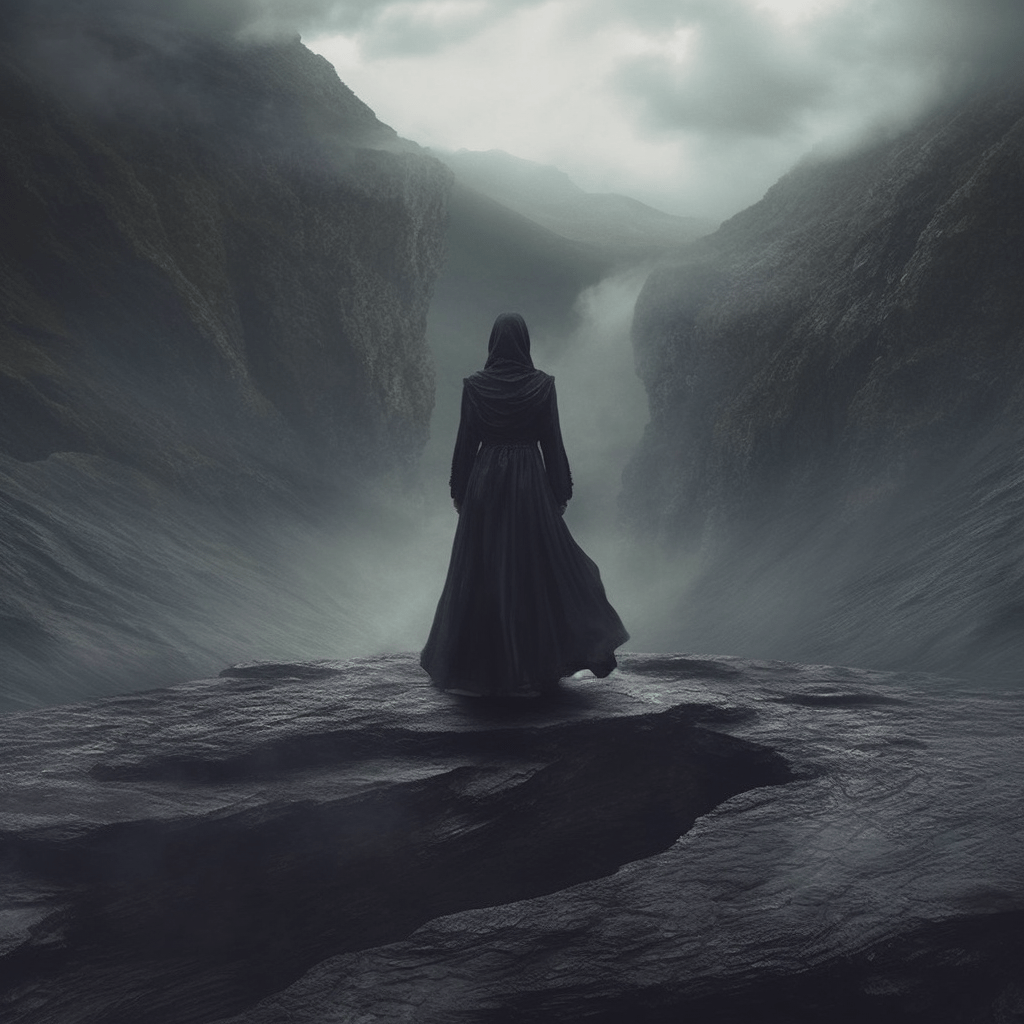
Picture generated by Midjourney
 Tales from the Swiss Mountains / Märchen aus den Schweizer Bergen