
The last lord of Starkenstein Castle was visited by a close relative, and it was decided to undertake a grand hunt to the Neuenalp opposite, where chamois, deer and stags were plentiful at that time.
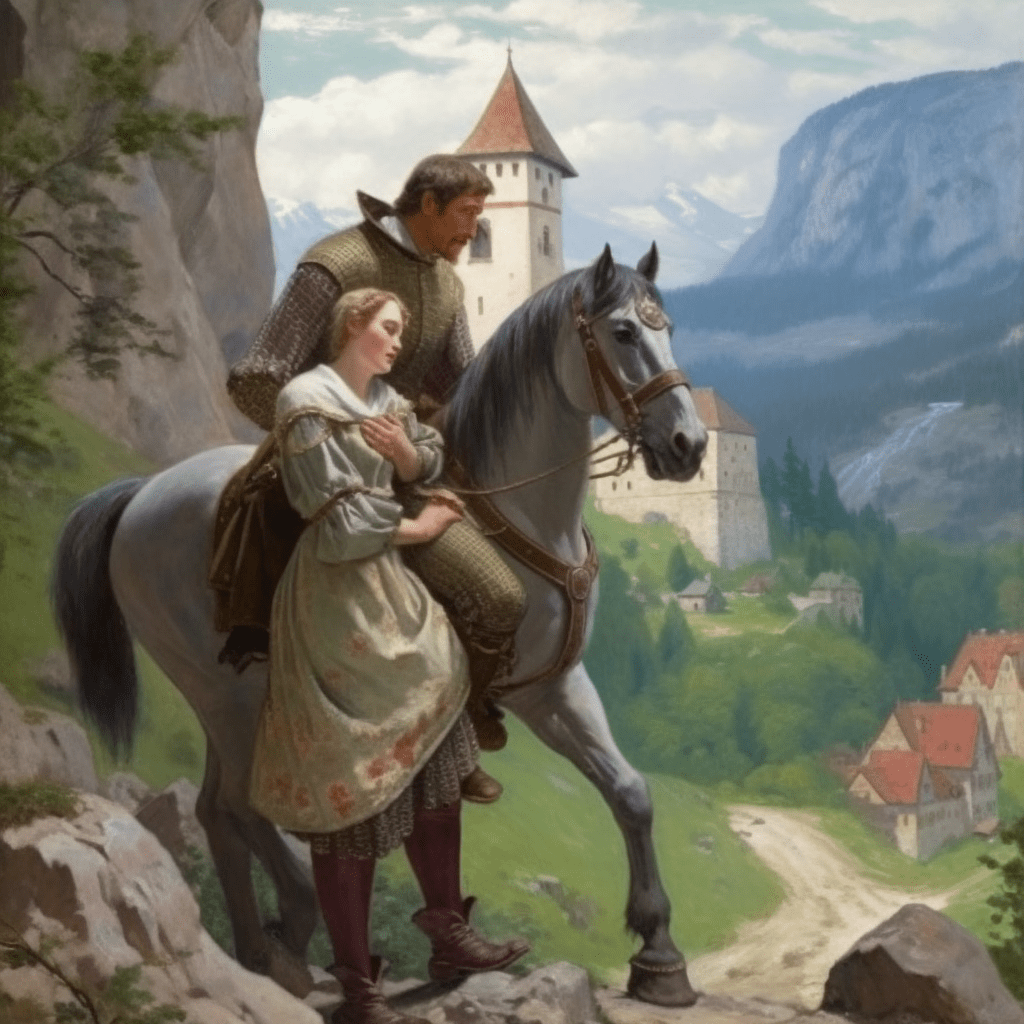
On a bright summer morning, the horns sounded for the hunt. The hunters prepared themselves and the farmhands fed the horses and the hounds. Soon the bailiff appeared, next to him his cousin, and behind them their companions. The hunters mounted their steeds and rode off at a gallop. The hounds were let loose and their barking soon revealed that they had tracked down the game. The bailiff had ridden ahead with some of his servants to the so-called “Neuenalp Stoffel“. Here he saw the most beautiful dairymaid far and wide, singing to the rows of cows in a silvery voice and blowing her alphorn from time to time. Her blond hair, rosy cheeks, slender figure and easy-going nature made the reeve want to steal her and take her with him to the castle.
However, he did not dare to do it openly, but thought of a ruse. The bailiff asked if she would not prepare breakfast for him and his people. Guilelessly she went with the guests to the hut where the brother was busy securing the cows. A simple meal was soon prepared. While it was being happily eaten, one of the gentlemen asked very nicely if the girl’s brother would bring him a drink of fresh water. As he was filling the bucket at the spring, he heard a muffled cry, and to his horror he saw his sister being put on horseback and galloping down the hill in the greatest possible haste. He rushed to his neighbours, and immediately a band of bold lads with scythes, forks and other implements was on the heels of the robbers. Wood and stones hurled at the impudent mob; the horses became spooked and fell; only the bailiff with two squires escaped with their skins intact.
The story of the girl’s theft spread like wildfire through the valley and from house to house. All those who could defend themselves armed themselves and marched against the castle to tear it down and punish the bailiff for his outrage.
As the lord of the castle came to the moat, a woman grabbed the reins of his horse and at the same moment he was hit by an arrow and fell from his horse, dead.
According to the legend, the archer would have been standing in the Iltishag meadow opposite the castle square and from there would have driven the arrow into the sacrilegious man’s chest. A master shot! For the distance must have been at least 400 to 500 paces. The young dairymaid jumped off her horse and embraced her mother, who had saved her. The shooter is said to have been lying in wait for the bailiff in a bush, without knowing anything about the girl.
Now it was the castle’s turn. The knights and servants who were inside surrendered at their mercy. Afterwards, the nest was plundered, and soon after, the flames of light proclaimed freedom to the valley.
Since then, the spirit of the bailiff in the shape of a poodle has guarded his money. A golden chain holds the monster captive, and whoever frees it from its bonds receives the hidden treasures. He often takes the form of a human being; then he wails and curses his servants who have advised and helped him to do so much evil.
He is said to have addressed passing travellers and thrown money at them in the hope that they would free him.
Some were already lusting after that treasure. But everything that had been tried so far was of no avail, for the wretch is said to have sworn in his last moments that all his possessions would be lost in the air, so that they would not lie in the depths of the ground, but invisible to ordinary human children high above the earth.
At night, at the twelfth hour, preferably on Christmas Eve, the squires come down the Neuenalp stream with the beautiful Lise, accompanied by a terrible howl of wind in the beech and fir treetops. As soon as they reach the river Thur, they begin a terrible scream and continue it through the whole night until the first cock-call.
This is what many fathers and grandfathers say they heard in stormy weather when they were still young. The noise is said to have reached their ears and hearts.
In more recent times, it seems that gold and silver have disappeared into the air and the castle spirits have come to eternal rest; for today, only the roar of the waters and the whispering and roaring of the winds are heard in that place.
By Fritz Grob.
At the ruins of Starkenstein Castle, the great castle dog still makes the rounds at certain times; it is the tyrannical lord of the castle who kidnapped a peasant girl and was pierced by an arrow in the window recess of his castle for doing so. His corpse was thrown into the Thur river by the enraged peasants.
H. Brunner.
Editor’s notes: This is awesome! This has everything, both hyper-local landscape references and elements, such as the Ghost Poodle guarding hidden treasure which are found across the German folklore. Some interesting elements that I am not clear about – is the Bailiff (Vogt) the same person the Lord (Zwingherr/Burgherr), it’s not completely clear.
Another interesting ambiguity is: “Die junge Sennerin sprang vom Pferde und umschlang ihre Mutter; denn diese war ihre Retterin gewesen” So does this mean that it was the mother that did the master bow shot that killed the lord? Or is the mother the woman that grabs (fell onto) the reins of the horse, which by implication saves the daughter from also being hit by the arrow?
- Burg Starkenstein.
Der letzte Zwingherr auf Schloss Starkenstein wurde von einem nahen Verwandten besucht, und es ward beschlossen, eine grossartige Jagd nach der gegenüberliegenden Neuenalp zu unternehmen, wo es dazumal Gemsen, Rehe und Hirsche die Menge gab.
An einem heitern Sommermorgen ertönten die Hörner zur Jagd. Die Jäger rüsteten sich, und die Knechte fütterten die Rosse und die Hunde. Bald erschien der Schlossvogt, neben ihm der Vetter, hinter beiden ihre Begleiter. Die Jäger schwangen sich auf ihre Rosse und ritten im Galopp davon. Die Hunde wurden losgelassen, und bald verriet ihr Gebell, dass sie das Wild aufgespürt hatten. Der Vogt war mit einigen seiner Bedienten vorausgeritten bis in den sogenannten “Neuenalp Stoffel”. Hier sah er die schönste Sennerin weit und breit, die mit silberheller Stimme den Kuhreihen sang und von Zeit zu Zeit in ihr Alphorn blies. Ihr blondes Haar, ihre rosigen Wangen, ihre schlanke Gestalt und ihr ungezwungenes Wesen erweckten in dem Vogt das Gelüste, sie zu stehlen und mit sich auf das Schloss zu bringen.
Er getraute sich aber nicht, es gleich offen zu tun, sondern dachte auf eine List. Der Vogt fragte, ob sie für ihn und seine Leute nicht ein Frühstück bereiten würde. Arglos ging sie mit den Gästen in die Hütte, wo der Bruder mit dem Einbinden der Kühe beschäftigt war. Ein einfaches Essen war bald bereitet. Während man es fröhlich verzehrte, bat einer der Herren gar artig, es möchte der Bruder des Mädchens ihm doch einen Trunk frischen Wassers bringen. Wie dieser den Eimer bei der Quelle füllt, vernimmt er einen dumpfen Schrei, und zu seinem Schrecken wird er gewahr, wie man seine Schwester zu Pferde setzt und alsogleich in möglichster Hast den Berg hinuntergaloppiert. Da eilt er zu seinen Nachbarn, und augenblicklich ist eine Schar kecker Burschen mit Sensen, Gabeln und Arten den Räubern auf den Fersen. Holz und Steine stiegen auf die freche Rotte; die Pferde werden scheu und stürzen; nur der Vogt mit zwei Knappen kommt mit heiler Haut davon.
Allein wie ein Lauffeuer kam die Geschichte vom Mädchenraub ins Tal und dort von Haus zu Haus. Alles, was sich wehren konnte, bewaffnete sich und zog gegen die Burg, um sie niederzureißen und den Vogt seines Frevels wegen zu strafen.
Wie der Burgherr zum ersten Laufgraben kommt, fällt ihm ein Weib in die Zügel des Pferdes, und im gleichen Augenblicke wird er von einem Pfeile getroffen, dass er tot vom Rosse sinkt.
Nach der Sage hätte der Schütze in der dem Schlossplatz gegenüberliegenden Weid Iltishag gestanden und von dort sein Geschoss in des Frevlers Brust gejagt. Ein Meisterschuss! Denn die Entfernung muss wenigstens 400 bis 500 Schritte betragen haben. Die junge Sennerin sprang vom Pferde und umschlang ihre Mutter; denn diese war ihre Retterin gewesen. Der Schütze soll in einem Gebüsch auf den Vogt gelauert haben, ohne von dem Mädchen etwas zu wissen.
Nun galt es der Burg. Die Ritter und Diener, die drinnen waren, ergaben sich auf Gnade. Nachher wurde das Nest geplündert, und bald darauf verkündeten die lichterlohen Flammen dem Tale die Freiheit.
Seitdem solches geschehen, soll der Geist des Vogtes in Gestalt eines Pudels sein Geld bewachen. Eine goldene Kette halte das Ungeheuer gefangen, und wer es von seinen Banden erlöst, erhält die Verborgenen Kostbarkeiten. Oft nehme er auch Menschengestalt an; dann jammere er und verfluche seine Diener, die ihm zu so vielem Bösen geraten und geholfen hätten.
Vorübergehende Reisende soll er angeredet und ihnen Geld zugeworfen haben in der Hoffnung, man werde ihn befreien.
Mancher gelüstete schon nach jenem Schatze. Alles aber, was bisher versucht morden, half nichts; denn der Unglückselige soll in seinen letzten Zügen noch seine ganze Habe in die Luft geschworen haben, also dass sie nicht im tiefen Grunde liegt, sondern unsichtbar für gewöhnliche Menschenkinder hoch über dem Erdboden.
Nachts in der zwölften Stunde, vorzugsweise in der Christnacht, kommen auch die Knappen mit der schönen Lise den Neuenalp-Bach herabgefahren unter schrecklichem Windesgeheul im Buchen- und Tannengewipfel. Sobald sie an die Thur gelangen, beginnen sie ein entsetzliches Geschrei und setzen es fort durch die ganze Nacht bis zum ersten Hahnenruf.
So wollen’s viele Väter und Grossväter, als sie noch jung gewesen, bei stürmischem Wetter gehört haben. Schauderhaft soll das Gelärm zu ihren Ohren und Herzen gedrungen sein.
In neueren Zeiten scheint es, dass Gold und Silber in den Lüften verschwunden und die Burggeister zur ewigen Ruhe gekommen wären; denn heute wird an jener Stelle nur noch das Rauschen der Wasser und das Sausen und Brausen der Winde gehört.
Durch Fritz Grob.
Bei den Trümmern der Burg Starkenstein macht zu gewissen Zeiten der grosse Schlosshund immer noch die Runde, es ist der tyrannische Schlossherr, der ein Bauernmädchen entführte und der dafür in der Fensternische seiner Burg von einem Pfeil durchbohrt wurde. Seinen Leichnam haben die erzürnten Bauern in die Thur geworfen.
H. Brunner.
Picture generated by Midjourney
 Tales from the Swiss Mountains / Märchen aus den Schweizer Bergen