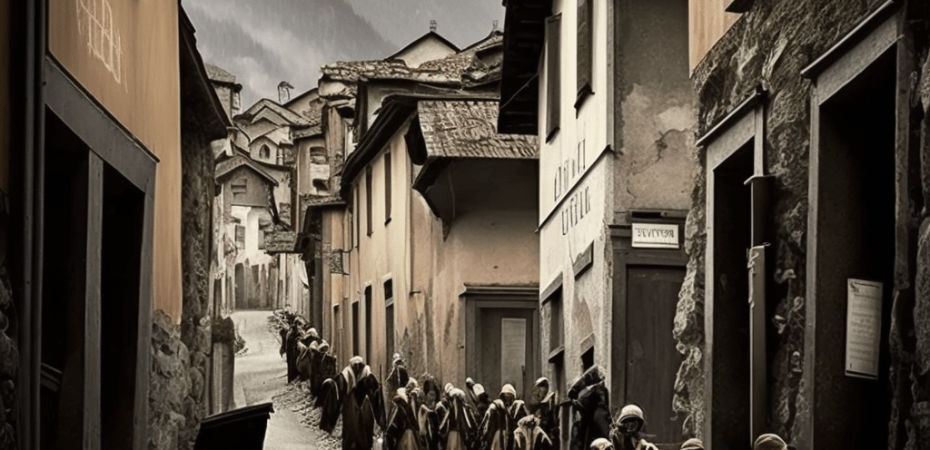
In the year 1565, an unfortunate pestilence raged so cruelly that in the village of Mosnang only 93 people remained, 30 whom God had spared from such terrible evil in mercy, 33 who had been attacked by the unfortunate plague but had risen again fresh and healthy, and 30 were so weak that one was never allowed to leave them, so that one did not know which would die first. This contagious pestilential epidemic lasted for several years, and every year for two to three months, during which time the venerable Mr. Bartholomä Fust, pastor here, and with him from the village of Mosnang alone, about 230 people died.
From St. Verena’s Day in 1565 until the consecration of the church in 1569, no less than 528 people succumbed to this evil, almost half of the parishioners according to the population at that time. Likewise, the Reverend Jakob Philipp Stössel and his sacristans were also stricken by this disease. Of these sacristans four of them died in one month and two others were very ill, but recovered through God’s help. However, one of these two had already been given the tree of death (last rites) because he was thought to be dead, but he lived for many years afterwards.
The evil was so great and the death so great that the people of the community of Mosnang were not allowed to go anywhere; they fled from all the streets and markets; in the towns and in the countryside they were separated from everyone, like the sick and lepers. For such a plague was quite new and had not been seen in men’s minds for a long time. In 1565, this painful addiction and this often cruel death also came to the Libinger Gebirg and to Halden. There, only two children were left out of some 40 people, and one of them fled, but later died of the plague. The plague has increased so cruelly in Halden, Engelbolgen, Vettigen, auf dem Stein, Libingen and other places that the parish priest and sacristan had to spend half a day and a whole night with the Holy Sacraments to the sick without stopping. The parish priest and the sacristan had to go to the sick for half a day and the whole night without stopping to administer the holy sacraments, so that some died during the sacred act.
Now it is to be known that the venerable Reverend Jakob Philipp Stössel, with the approval and heartfelt vows of the entire community of Mosnang, has vowed three cloisters with extended arms (in the truest possible devotion) around the village on all four streets, which every parish priest is now obliged to proclaim annually from the pulpit, the first on the Friday before St. Gall’s Day, and to perform faithfully. And should the weather be unfavourable on one of the three Fridays, the devotional exercises shall be held in the church. The parishioners are to be admonished in all earnestness every year that they also faithfully fulfil their vow and promise, so that the Most Holy Trinity, through the intercession of the Virgin Mary, the patrons of the church and parish, St. George and St. Theodore, St. Sebastian and all the dear saints, may graciously protect, shield and preserve the whole parish and the whole of Christendom from such gloomy times, great and common misery, now and in all times. Amen.
From the booklet: “Devotional Exercises for the Three Prayer and Penitential Walks on All Four Roads for the Parishioners of Mosnang” by Pastor Heinrich.
By J. Moser.
- Pest, 1565 – 69.
Im Jahre 1565 wütete eine leidige Pestilenz so grausam, dass im Dorfe Mosnang nur noch 93 Personen übrig geblieben, 30, die Gott vor so schrecklichem Übel in Gnaden verschonet, 33, die zwar von der leidigen Pest überfallen worden, jedoch wieder frisch und gesund aufgestanden sind, und 30 waren so schwach, dass man sie nie verlassen durfte, so dass man nicht wusste, welche zuerst sterben würde. Diese ansteckende pestilenzische Seuche dauerte etliche Jahre, und jedes Jahr beiläufig zwei bis drei Monate, während welcher Zeit der wohlehrwürdige Herr Bartholomä Fust, Pfarrer in hier, und mit ihm aus dem Dorfe Mosnang allein ungefähr 230 Personen starben.
Von St. Verena-Tag 1565 bis aus die Kirchweihe 1569 sind nicht weniger als 528 Leute diesem Übel erlegen, nach damaliger Volkszahl beinahe die Hälfte der Pfarrkinder. Desgleichen ist auch der Hw. Herr Pfarrer Jakob Philipp Stössel samt seinen Mesnern von dieser Krankheit ergriffen worden. Von diesen Mesnern sind vier in einem Monat gestorben und zwei andere auch schon sehr krank gelegen, aber durch Gottes Hilfe wieder gesund geworden. Doch ist einem von diesen beiden auch schon der Totenbaum gemacht worden, weil er für tot gehalten wurde; er hat jedoch nachher noch etliche Jahre gelebt.
Das Übel war so gross und das Sterben so viel, dass die Leute aus der Gemeinde Mosnang nirgends hin haben wandeln dürfen; man floh sie auf allen Strassen und Märkten; in den Städten und auf dem Lande wurden sie, wie die Siechen und Aussätzigen, von jedermann abgesondert. Denn solche Pest war ganz neu und bei Mannsdenken und länger kein solches Sterben gewesen. Anno 1565 ist diese leidige Sucht und dies vielfach grausame Sterben auch in das Libinger Gebirg und nach Halden gekommen. Dort sind von etlichen und 40 Personen nur noch zwei Kinder übrig geblieben, und eines ist geflüchtet worden, das später dennoch an der Pest gestorben. Diefe leidige Pestilenz hat zu Halden, Engelbolgen, Vettigen, auf dem Stein, zu Libingen und der Orten so grausam zugenommen, dass der, Pfarrherr und Mesner einen halben Tag und eine ganze Nacht ohne Aufhören mit den heil. Sterbsakramenten zu den Kranken gehen mussten, so dass etliche während der heiligen Handlung gestorben sind.
Nun ist zu wissen, dass der wohlehrwürdige Herr Pfarrer Jakob Philipp Stössel mit Bewilligung und herzlichem Verloben der ganzen Gemeinde Mosnang drei Kreuzgänge mit ausgespannten Armen (in möglichst wahrer Andacht) um das Dorf auf alle vier Strassen angelobet, welche nun fürderhin und zu ewigen Zeiten ein jeder Pfarrer schuldig ist, jährlich von der Kanzel zu verkünden, den ersten am Freitag vor St. Gallentag, getreulich zu verrichten. Und sollte die Witterung an einem der drei Freitage gar ungünstig sein, sollen die Andachtsübungen in der Kirche gehalten werden. Das Pfarrvolk ist alljährlich allen Ernstes zu ermahnen, dass selbes dem Gelübde und Versprechen ebenfalls getreulich nachkomme, damit die allerheiligste Dreifaltigkeit auf die Fürbitte der jungfräulichen Mutter Maria, der hl. Kirch- und Gemeindepatronen Georg und Theodul, des hl, Sebastian und aller lieben Heiligen die ganze Gemeinde und die gesamte Christenheit vor solch trübevollen Zeiten, grossem und gemeinem Elend jetzt und zu aller Zeit gnädigst beschützen, beschirmen und bewahren wolle. Amen.
Aus dem Büchlein: “Andachtsübungen bei den drei Bitt- und Bussgängen auf alle vier Strassen für die Pfarrkinder zu Mosnang” von Pfarrer Heinrich.
Durch J. Moser.
Picture generated by midjourney

 Tales from the Swiss Mountains / Märchen aus den Schweizer Bergen