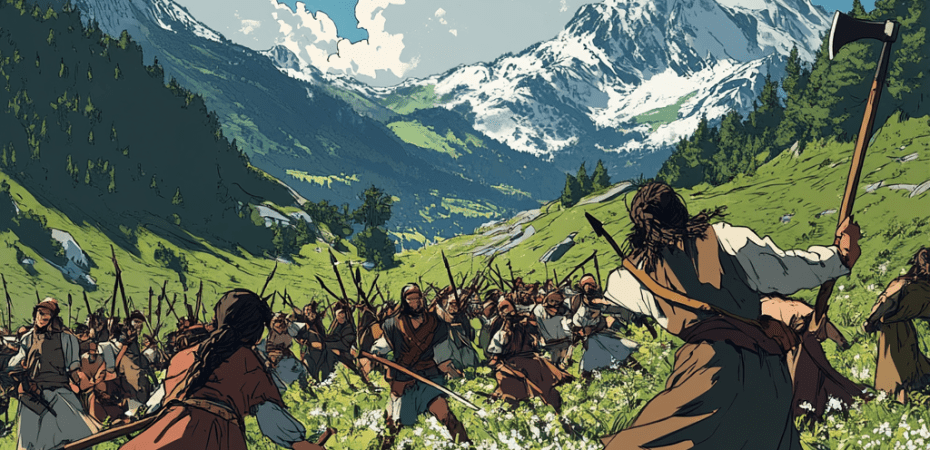
From the village of Grabs, a wide road leads up the Grabierberg to the beautiful blue lake, where cows can drink the water when they go to the alp. If you then go further along the footpath, you come to the Jschlawiz alp, where every year the tufted cows are summered. In the middle of the alp there are two hills, which are covered with alpine roses in the summer, so that they are just as beautiful as gardens.
There is also a magnificent valley between the two hills inside, and the old people know how to tell you a wonderful story that makes your head spin. One Sunday, when the people had just gone to church, the Toggenburgers went to the same alpine pasture and stood there.
Of course, the dairymen didn’t know what to do and fought them off. However, they were beaten by the big Toggenburgers and taken to the south of Schottä. A single drunk dairyman went with his alpine horn into a large field and shouted what he could into the village: “Come on, you citizens, young and old, the Toggenburgers steal everything!” But he made such a fool of himself that he fell off the big one. The priest’s maid came out and heard everything. She was not happy and ran into the church and told the whole community.
The men now abandoned the priest and rushed up and down to save their cows. One of them took a Furggä, the other a Segis, the third a Är, in short, whatever came to hand. The wives fell on their knees and prayed that the good Lord would help them. And then the Grabsburgers found the Toggenburger just in the valley where I told you before, and when a bugle was heard, the women knew it was that it was safe again.
From that day on, the valley is known as the Battlefield.
Many centuries ago, the Toggenburgers came to the Grabs Alps and robbed the cattle after throwing the herdsmen and shepherds headfirst into the boiling milk. Only one shepherd managed to escape this terrible death. He climbed a fir tree and blew through the Bürchel (bark mouthpiece):
“‘s Heara Chue heisst Blässi,
Un d’Toggenburger ‘nenn is ‘s Beh un ‘s Chessi!”
He blew so hard and so long that he sank down dead. Catherine, the priest’s cook, heard and recognised her lover’s voice, jumped into the church and told the worshippers what she had heard.
The men rushed up with halberds and other weapons of war and took the stolen beast from the Toggenburgers after bloody fighting. The place where this battle took place is called the Battlefield. Old weapons were found there long after the battle had ended.
It is told in Sarganserland and Toggenburg. The alpine dairyman with the “Bürchel” is a legendary ingredient that is often told in Bünden. However, it is also based on a real event from the time of the old Zurich war.
Oral in Swiss German (help needed to get this translation right so I have typed it out below)
‘s Schlachtbödeli
Vom Dorf Grabs uus goht ä wüast Strössli an Grabierberg ufi bis zum änä schonä, blauä Seä, wo denn Küä dä Summar, we mä z’Alp gfahrä ist, gunn go Wasser tringgä. Goht mä denn dir nän Fuässweg no witer obsi, so chunnt mä in d’Alp Jschlawiz, wo alli Johr ütschä tufig Küä gsummärät werden. Zmitet in d’r Alp dinnä sin zwei Hügäl, diä dä Summer über und über mit Alpärosä deggt sin, so dass sie grad anzuägä sin, wiä rächt wunderschöni Gärtä.
Au zwüschä denä zwei Hüglä innä ist ä prächtigs Täli, und die altä Lüt wüssen eim ä schüdlägi Gschicht dävo z’verzellä, dass eim d’Hoor däbei grad ufftoh chönnten. Nämli Toggäburgär seien ämol änä Sunntig, wo d’Lüt gad in dr Kilchä gin sin, in dieselb Alp cho und heien’s Beh wellä stehlä.
D’Senna hen’s natürli nit mir nüt dir nüt gschehä Io und hen sie wagger gwehrt. Sie sin aber vo benä grobä Toggäburgärä paggt und in die südig Schottä innä gworfä wordä. An einzigä Sennäbuäb ist ertrunnä und ist mit sim Alpähorn uf än Grosse ufi Flädärät und het druf, was er hät mögä, ins Dorf abi grüäft : “Uf, ihr Burä, jung und alt, Toggärburger stehlen alls !” Er het aber so starch blosä, dass er drob toäd ab äm Grosse abä gfallä ist. Zuafallig ist s’Pfarreres Magd grad vorosä gstannä und het alls ghört. Si nit ful und lauft in d’Kilchä und seit’s dr ganzä Gmei.
D’Mannä henn jetz dä Pfarrär im Stich glo und sin uf und dervo, was gist was hest, iri Küä go rettä. Dr ei het ä Furggä gnoh, dr andr ä Segis, dr dritt än Är, churzum, was nä in d’Fingär cho ist. D’Wiber sin uf Kneu nidärgfallä und hen bettät, das doch dr liäb Gott inä helfä möcht. Unerdessä hen Grabserburä d’Toggäburger grad in dem Täli übercho, won i vorig versellt ha dervo, und hen nä der Buggl ghörig durbläut, dass nä ‘s Stehlä sichär für nä Wil vergangä ist. Vom selbä Tag an het selb Täli dä Ramä Schlachtbödeli übercho.
Vor vielen hundert Jaren kamen die Toggenburger auf die Grabser Alpen und raubten das Vieh, nachdem sie die Sennen und Hirten kopfüber in die siedende Milch geworfen hatten. Nur einem Hirten was es geglückt, diesem furchbaren Tode zu entrinnen. Er kletterte auf eine Tanne und blies durch den Bürchel (Sprachrohr aus Rinde):
“‘s Heara Chue heisst Blässi,
Un d’Toggenburger ‘nenn is ‘s Beh un ‘s Chessi!”
Er blies so stark und so lang, dass er tot niedersank. Katharina des Pfarrers Köchin, hörte und erkannte die Stimme ihires Geliebten, spring in die Kirche und meldete den Betenden, was sie vernommen.
Die Männer eilten mit Hellebarden und andern Kriegswaffen hinauf und nahmen den Toggenburgern nach blutigen Streiten das geraubte Bieh wieder ab. Die Stätte, wo dieser Kamp stattgefunden heist Schachtboden. Noch lange nachher fand man dort alte Waffen.
Heinrich Hilty
Wird such in Sarganserland und Toggenburg erzählt. Der Senne mit dem “Bürchel” ist eine sagenhafte Zutat, die uns verahmung; denn sie in Bünden merhfach erzählt. Ihr liegt aber auch hier ein wirkliches Geschehnis aus der Zeit des alten Zürichkrieges zu Grunde.

 Tales from the Swiss Mountains / Märchen aus den Schweizer Bergen