
Holy Father Gallus, in his old age, went once more from where he had come to consolidate a place of Christian splendour through his work. In Arbor Felix he ascended the pulpit for the last time in order to describe the downfall of all earthly things in a profound way to those gathered; then he himself, the strong fighter, the aged hero, departed forever from earthly lust and earthly torment.
“The Master is no more”, lamented the brothers in St. Gallen’s monastery cells.
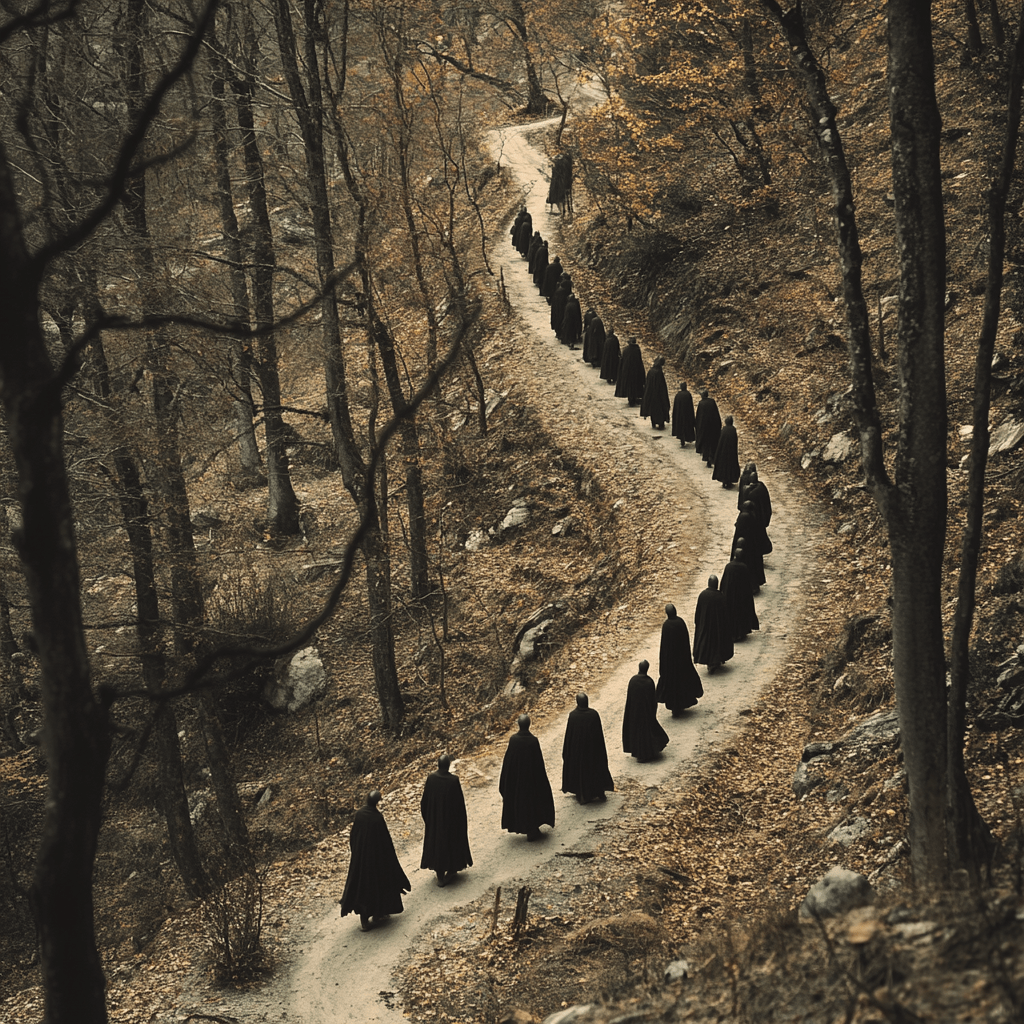
To fetch his body, they hurried down the winding path that led them over Rotmonten and further along a narrow lane to the shore of the lake. From Arbon, a funeral procession met them at the same hour as far as Berg, to “Howenbühl” [Hohenbühl] and then past Gommiswil [Gommenschwil].
Another short distance and the funeral procession met with St. Gallen’s friars. A cross was erected in the same place for eternal remembrance, and this cross is still standing, even if it has probably been rebuilt many times; it is the cross at Höfen. Soon there was a “fründlich Hus” (friendly house) near the cross, and “sin Inwohner” (? inhabitants), wisely thinking and caring, gained land and property around it for their own free possession.
They called themselves “von Hofen“. Their lineage has died out, but their estates still bear the name today and probably for ever. But not only a cross was to mark the place; after a short time the brothers decided that a chapel, simple but worthy of its purpose, should be dedicated to the memory of their master in a suitable place. And it was built on a level site.
There it stood until it had to fall down, decrepit and rotten. Where it once stood, there is still a wayside shrine near the hamlet of Kappel.
By L. Jäger
Der Bildstock bei Kappel
Der hl. Vater Gallus zog hochbetagt noch einmal hin, von wo er ausgegangen, um eine Stätte christlichen Glanzes durch sein Wirken zu festigen. In Arbor felix bestieg er zum letzten Mal die Kanzel, um von ihr herab den Untergang alles Irdischen tiefergreifend den Versammelten zu schildern; dann schied er selbst, der starke Kämpfer, der greise Held; er schied für immer von Erdenlust und Erdenpein, “Der Meister ist nicht mehr”, so klagten jammernd die Brüder in St. Gallens Klosterzellen. Seinen Leichnam abzuholen, eilten sie den vielgewundenen Pfad hinab, der sie über Rotmonten und weiterhin führte in einer hohlen Gasse bis an den Seestrand. Von Arbon her zog zu gleicher Stunde ein Leichenzug ihnen entgegen bis Berg, nach “Howenbühl” [Hohenbühl] und dann bei Gommiswil vorbei. Noch eine kurze Strecke, und der Trauerzug traf zusammen mit St. Gallens Ordensbrüdern. An selber Stell ward ein Kreuz emporgerichtet zum ewigen Gedenken, und dieses Kreuz steht noch, wenn wohl schon oft erneut; es ist das Kreuz zu Höfen. In des Kreuzes Nähe stand bald ein “fründlich Hus”, und klüglich sinnend, sorgend, gewannen “sin Inwohner” Land und Gut umher zu freiem, eigenem Besitz. Sie nannten sich “von Hofen.” Ihr Geschlecht ist ausgestorben, doch ihre Güter tragen ihn noch heute und wohl für immerdar. Doch nicht ein Kreuz allein sollte den Ort bezeichnen; die Brüder beschlossen nach kurzer Frist, dass eine Kapelle, schlicht, doch ihres Zweckes würdig, an passender Stelle dem Gedenken ihres Meisters geweiht sein solle. Und sie wurde erbaut auf ebenem Plan. Dort stand sie, bis sie altersschwach und morsch auch stürzen musste. Wo sie dereinst gestanden, da findet sich beim Weiler Kappel heute noch ein Bildstock.
Durch L. Jäger
 Tales from the Swiss Mountains / Märchen aus den Schweizer Bergen