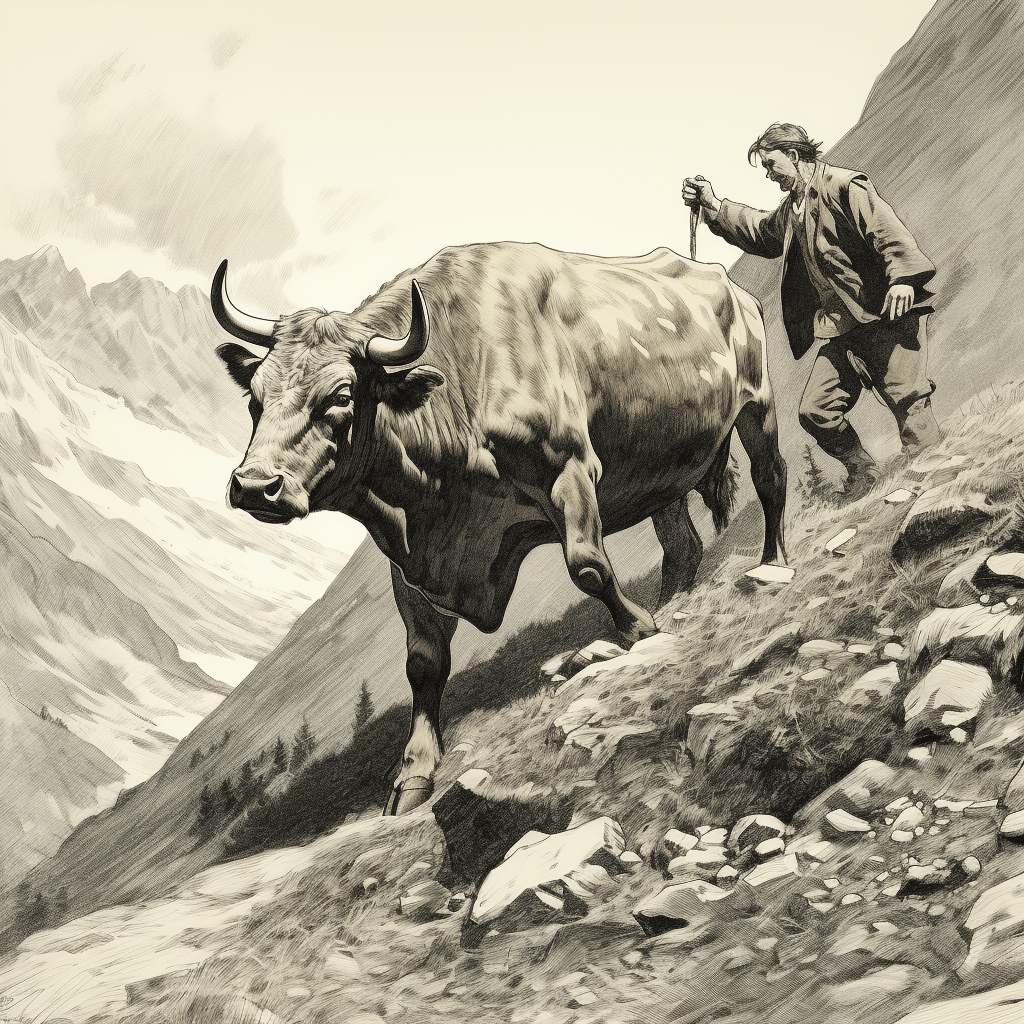
A poor widow’s cow was the only one in a barn at Fursch. This cow was the bane of the cowman. Always and always she climbed up rocks and over precipices after the “Zöchtgras” and tempted others to do the same. She became worthless to the herder. He laid freshly peeled fir bark on the path. As soon as the cow stepped on it, it slipped, tumbled down the rock face and crashed in the wooded abyss, the herder shouting with joy.
Many years later, a charcoal-burner was burning charcoal in the forest below. When the weather changed, he heard whooping in the night and then groaning and moaning again. He called out into the darkness to find out what it was. Then someone came up to him and told him that he was the cowman and had to carry the “fallen” cow up the cliff with groans and groans. There the cow would stand on the fir bark again, slip and fall down. Then he had to shout. As often as he carried the cow up, he could atone for the damage he had done to the poor woman. He was allowed this as a special favour because he was only seventeen years old at the time of the offence; otherwise he would have been eternally lost.
J. B. Stoop
Editor’s note: “Zöchtgras” was the first time that search engines came up with nothing except the version on Sagens.at. This must be a very local and/or archaic term for a type of grass that is like catnip for cows.
What the special favour is, I’m not clear. It could be that the herder is still alive when he meets the charcoal burner and is only condemned to repeat this Sisyphean task whilst living and not for all eternity as a wraith.
302. Der Küher
In einer Sente zu Fursch war auch die einzige Kuh einer armen Witfrau. Diese Kuh war das Kreuz des Kühers. Immer und immer stieg sie auf Felsen und über Abgründen dem “Zöchtgras” nach und verleitete auch andere dazu. Dem Hirten wurde sie unwert. Er legte auf dem Stollen frischgeschälte Tannenrinde hin. Sobald die Kuh darauftrat, rutschte sie aus, stürzte über die Felswand hinunter und zerschmetterte im waldigen Abgrund, Der Hirt jauchzte vor Freude.
Viele Jahre später brannte im Walde unten ein Köhler Holzkohlen. Beim Wetterwechsel hörte er in der Nacht jauchzen und dann wieder ächzen und stöhnen. Nun rief er in das Dunkel hinaus, was das sein solle. Da trat einer zu ihm und erzählte, er sei der Küher und müsse die “erfällte” Kuh mit Ächzen und Stöhnen auf den Stollen hinauftragen. Dort stehe die Kuh wieder auf die Tannenrinde, rutsche aus und falle hinab. Dann müsse er jauchzen. So oft er die Kuh hinauftrage, könne er einen Heller abbüssen an dem Schaden, den er der armen Frau zugefügt. Das sei ihm als besondere Gnade gestattet worden, weil er zur Zeit der strafbaren Handlung erst siebzehn Jahre alt war; sonst wäre er ewig verloren gewesen.
J. B. Stoop
Picture generated by Midjourney